
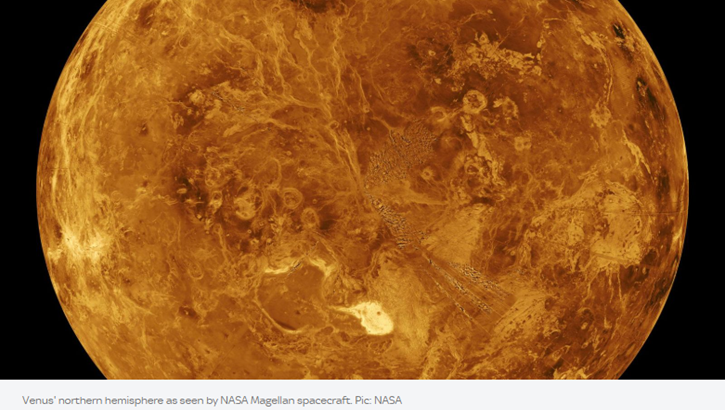
According to recent research by astrochemists from the University of Cambridge, Venus has always been dry, despite a long-running scientific controversy about whether it ever had liquid oceans.
“Two very different histories of water on Venus have been proposed: one where Venus had a temperate climate for billions of years with surface liquid water and the other where a hot early Venus was never able to condense surface liquid water.” Ms. Constantinou and her associates found that “the planet has never been liquid-water habitable” after modeling the atmosphere’s current chemical composition.
“Venus today is a hellish world,” NASA says. Its typical surface temperature is about 465C (869F), its pressure is 90 times higher than Earth’s at sea level, and it is constantly covered in dense, poisonous sulfuric acid clouds. The absence of hydrogen in the planet’s interior, as discovered by scientists, indicates that it is significantly drier than the Earth’s interior.
ALSO READ: A study shows that the next generation of space-borne lasers is being inspired by bacteria
According to the study, any water in Venus’ atmosphere most likely stayed as steam rather than condensing on the planet’s surface. The planet might have once been habitable, according to a group of experts from NASA’s Goddard Institute for Space Studies (GISS) in New York back in 2016.
The group employed a computer model that is comparable to those used to forecast Earth’s climate change.
“Many of the same tools we use to model climate change on Earth can be adapted to study climates on other planets, both past and present,” stated lead author of the publication and GISS researcher Michael Way at the time.
“These results show ancient Venus may have been a very different place than it is today.”
Last year, researchers at the University of Chicago claimed that Venus “has been uninhabitable for over 70% of its history, four times longer than some previous estimates” in another study.