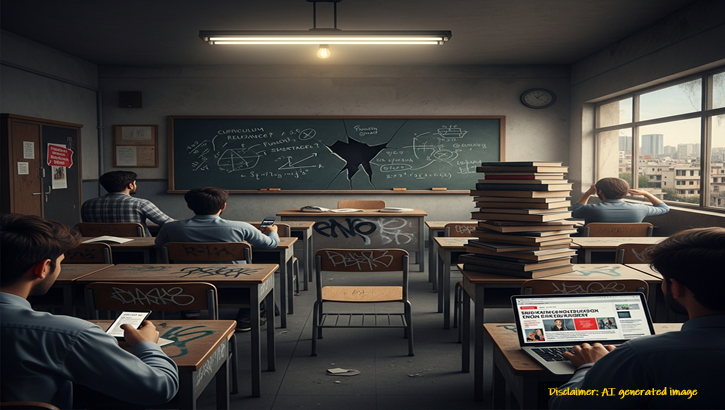
Higher Education System
Higher education is defined as ‘’any type of education offered in post-secondary institutions of learning, usually at the end of a course of study, a degree, diploma, or certificate of higher education.’’ Junior colleges, technological institutes, and teacher training schools are examples of higher education. In addition to universities and colleges, higher education institutions also include a variety of vocational schools that offer training in disciplines including law, theology, medicine, business, music, and art. Junior colleges, the Institute of Technology, and teacher training institutions are examples of higher education. Higher education is defined by the Oxford Dictionary as “education at a college or a university, especially to a degree level.” Higher education is now essential for Pakistani youth due to the country’s rapid population expansion.
ALSO READ: The featured articles published by PSM & Select the best journal for your submission: PSM Journals
The younger generation is desperate to get a top-notch education from prestigious universities in order to gain support from large corporations. As usual, though, the glass remains half empty. Pakistan’s higher education system is plagued by a number of problems, including bureaucratic “Red Tape” and a lack of related programs. The expensive price structure of the institutions and the traditional methods of instruction further hinder this. Along with low GDP investment in higher education, there is a discrepancy between the capabilities required by the sector and the credentials obtained. Even though our nation’s higher education system has many problems, the required changes can still be made.
The key to restoring Pakistan’s higher education system is a strong commitment to research and development. Additionally, there has been a notable decrease in corporation prices. It is evidently more profitable to concentrate on investing in technology rather than traditional brick and mortar businesses. In this sense, reorganizing the institutions is essential. Our educational system urgently needs to concentrate on developing entrepreneurs, inventors, scientists, philosophers, and writers rather than the objective of landing a job and joining the rat race. The change will be ensured by the policy framework’s implementation.
ALSO CHECK: Affordable Editing and Proofreading Services
Higher Education in Pakistan
There are serious concerns about the quality of higher education in Pakistan. The quality of education provided is still poor even though the number of higher education institutions in the nation is growing. The poor quality of education in Pakistan can be attributed to a number of factors, including outdated curricula, insufficient resources, and a shortage of skilled instructors.
Regarding infrastructure, the nation boasts a diverse array of public and private universities. There is a widespread belief that state-funded public schools are inferior to private ones in terms of educational quality. are typically thought to be of inferior quality than private institutions. Conversely, private schools and universities tend to be more costly and serve a more affluent group of people. This has led to a notable gap in the quality of education offered by public and private institutions and has also exacerbated the nation’s widening class division.
Lack of resources is one of the main issues affecting Pakistani higher education. Libraries, labs, and lecture halls are among the essential amenities that public institutions lack since they are frequently underfunded. Additionally, a lack of adequate finance has resulted in a scarcity of competent faculty. There is a teacher shortage in several Pakistani universities, which directly affects the standard of instruction given to students.
The inadequate infrastructure in Pakistan is another major problem for higher education. Many colleges and universities lack adequate computer laboratories, libraries, and classrooms. Students find it challenging to obtain the resources they require to excel in their studies when these fundamental amenities are lacking. Higher education cannot be enhanced without the right infrastructure, an appropriate budget, and transparent spending. If we are truly serious about developing high-quality knowledge, libraries, labs, and computer labs must receive special attention because they are the fundamental instruments for knowledge production.
ALSO READ: The featured articles published by ABMRC & Select the best journal for your submission: ABMRC Journals
The dearth of scholarships given to students is another obstacle that is connected to our earlier argument and frequently leads to the creation of subpar and badly written research. There is a general lack of “research culture” at our universities. The reason is that no government wants academics to create policies based on accurate data and research, and even when governments do recruit academics, they only give opportunities to qualified foreigners who are familiar with the state of our universities. However, this justification ought to be sufficient for us to think about this matter and act decisively so that our public institutions can meet our demands to the extent that we won’t require any foreign experts to formulate our policies.