
A recently published study shows that a protein that is misplaced within a cell can cause a number of illnesses, including cancer, Alzheimer’s, and cystic fibrosis. However, a single human cell has over 70,000 distinct proteins and protein variations, and since researchers can usually only test for a small number of them in a single experiment, manually locating proteins is very expensive and time-consuming.
A new generation of computational methods uses machine-learning models, which frequently use datasets with hundreds of proteins and their positions recorded across several cell lines, to try to expedite the process. The Human Protein Atlas is one of the biggest datasets of this type, listing the subcellular activities of more than 13,000 proteins in over 40 cell lines. Even though the Human Protein Atlas is a huge database, it has only examined only 0.25 percent of all potential combinations of proteins and cell lines.
A new computer method has now been created by researchers from MIT, Harvard University, and the Broad Institute of MIT and Harvard that can effectively explore the remaining unexplored space. Even in cases when neither the protein nor the cell have been studied previously, their technique can predict the location of any protein in any human cell line.
ALSO READ: A study shows Starch-based Bioplastic possibly as toxic as petroleum based plastic
Instead of using an average estimate across all the cells of a particular kind, their method localizes a protein at the single-cell level, going one step farther than many AI-based approaches. For example, following treatment, this single-cell localization could identify the location of a protein in a particular cancer cell.
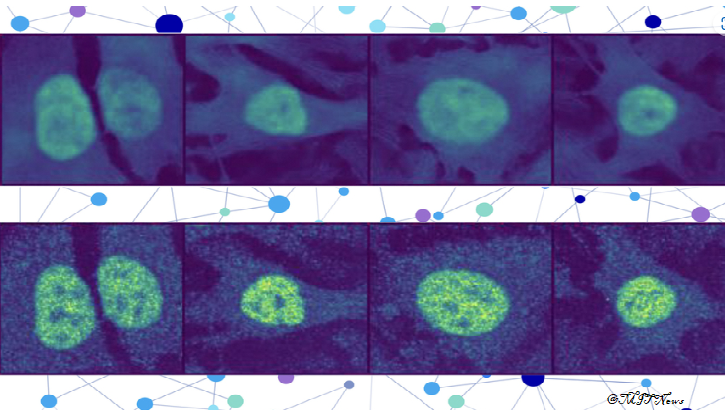
The researchers captured detailed characteristics about a protein and cell by combining a protein language model with a particular kind of computer vision model. When the model predicts the location of the protein, the user is shown with an image of a cell with a highlighted area. This method may help researchers and clinicians more quickly diagnose illnesses or find potential drug targets because a protein’s location indicates its functional state. It may also help biologists better understand the relationship between protein localization and intricate biological processes.
Many protein prediction algorithms now in use are either unable to identify the location of a protein within a single cell or are only able to generate predictions based on the protein and cell data that they were trained on. To overcome these limitations, the researchers created a two-part method for prediction of unseen proteins’ subcellular location, called PUPS.
The first section uses a protein sequence model to capture a protein’s 3D structure and localization-determining characteristics based on the chain of amino acids that makes it up.
In order to fill in the gaps in an image, the second section includes an image inpainting model. By analyzing three stained images of a cell, this computer vision model can determine the cell’s kind, specific characteristics, and the presence of stress.
In order to estimate the location of the protein within a single cell, PUPS combines the representations produced by each model. An image decoder is then used to produce a highlighted image that displays the predicted location.
According to Tseo, “our model is able to understand that nuance,” meaning that various cells within a cell line exhibit different features.
The user enters the protein’s amino acid sequence along with three cell stain images: one for the endoplasmic reticulum, one for the nucleus, and one for the microtubules. PUPS then takes care of the rest.
The researchers employed a few tricks during the training process to teach PUPS how to combine information from each model so that it can make an informed estimate as to the location of the protein, even if it hasn’t seen it before.
Follow: ISA





One thought on “Researchers can use AI to predict the location of virtually any protein within a human cell”