
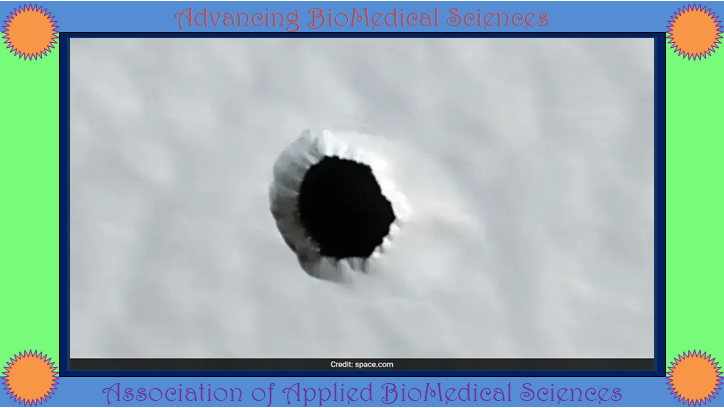
The strange hole on Mars has been photographed by the National Aeronautics and Space Administration (NASA). According to Space.com, this several-meter-wide hole on the side of an old volcano was first seen on August 15, 2022.
According to the investigation, NASA’s Mars Reconnaissance Orbiter (MRO) used a High-Resolution Imaging Science Experiment (HiRISE) camera to take a picture of this enigmatic hole on the edge of the now-extinct Arsia Mons volcano.
It was only 256 kilometers (159 miles) from Mar’s surface when NASA’s satellite took the picture.
According to popular belief, this mysterious hole is a vertical shaft.
According to the study, these holes may one day serve as housing for astronauts. Based on this reasoning, the study asserted, “They might serve as a future home for astronauts; Mars cannot protect itself from space radiation in the same manner as Earth since it lacks a global magnetic field and has a thin atmosphere. As a result, radiation exposure on the Martian surface is often 40–50 times higher than that on Earth.
These holes may also be useful in providing information about Martian life. The report went on, “The other alluring aspect of these pits is that they might hold astrobiological interest in the sense that they could have been sheltered abodes for Martian life in the past — perhaps even today if microbial life indeed exists there.” In addition, the pits might not only offer refuge for human astronauts.
These holes on the sides of volcanoes suggest that there is likely a connection between them and the volcanic activity on Mars. Lava channels can flow away from a volcano underground; the channel empties when the volcano goes extinct, according to the article. That leaves an extended subterranean tube in its wake. These tubes are visible not just on Mars but also on Earth and the moon.
The depth to which these holes delve is still unknown. It’s also uncertain if these holes are confined within a tiny, cylindrical depression or open onto a huge cavern.
The research concluded by speculating that these holes could eventually prove to be a better landing place for crewed expeditions to Mars if they expand out into caverns. For such a journey, the astronauts would have to construct a safe base camp away from the relentless radiation of the outside world.
Read our blog: AABMS Blogger